
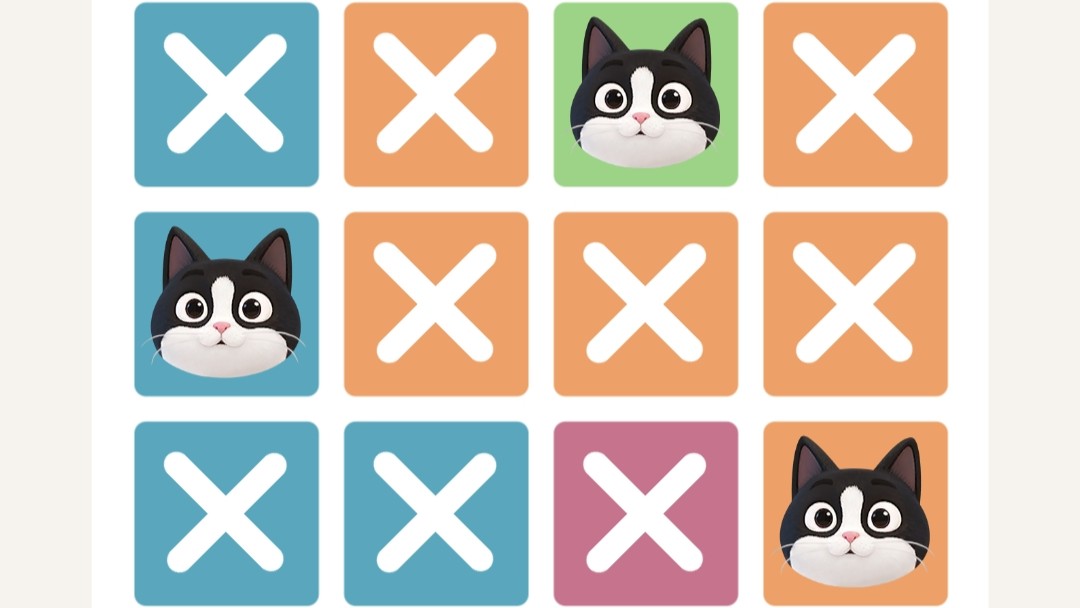
Meowdoku! isn’t just a pun. It’s a genuinely clever puzzle game that swaps numbers for cats and layers in fresh rules — one cat per color, cats can’t touch, even diagonally. It’s sudoku meets Minesweeper deduction, wrapped in an adorable cat-themed package.
Quick Verdict and Test Basis
- Test basis: at least 30 minutes of recorded hands-on play; the uncut gameplay segment and screenshots on this page are primary evidence.
- Best for: Logic-puzzle players who prefer deduction, short sessions and a low-pressure presentation.
- Watch for: A heart system penalises guesses, while live app features and ad behaviour may change by version.
- Verdict: A clean cat-themed logic puzzle with stronger intrinsic reasoning than monetisation pressure.
- Review updated: July 23, 2026. Store ratings, prices, downloads, events and ad frequency may change by version or region.
Our scores are editorial judgments, not scientific measurements. See the Editorial Policy for testing, sourcing, corrections and commercial disclosure rules.
Launching on May 19, 2026, the game already hit #1 on the App Store US free chart and Top 50 in 10 countries, with daily downloads nearing 150K. Curious why this feline puzzler is taking off? Let’s break it down with Yu-kai Chou’s Octalysis Framework — the gold standard for understanding what keeps us playing.
What Exactly Is Meowdoku!?
Meowdoku! blends two classic puzzle genres—Sudoku and Minesweeper—into one sleek package. You place cats on a grid. Every cat wants exclusive territory. That means exactly one cat per colored section, one per row, one per column, and they cannot touch each other. Not even diagonally. Zero personal space violations. You only get 3 mistakes per level before you lose a heart.
Octalysis Scorecard: How Meowdoku! Scores
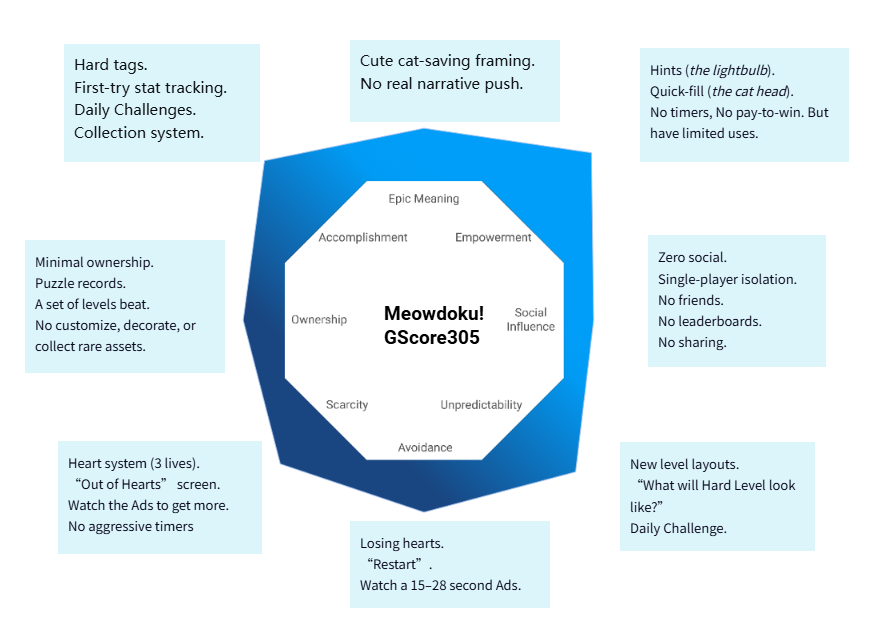
Here is a quantitative evaluation of Meowdoku! across the eight core drives.
| Core Drive | Score (1-10) | Key Design Manifestations |
|---|---|---|
| Epic Meaning & Calling | 5 | Cute cat-saving framing, but mostly about mastering logic puzzles. No real narrative push. |
| Development & Accomplishment | 8 | 60+ levels with Hard tags, 58%–74% first-try stat tracking, Daily Challenges with 11-hour timers, star collection system. |
| Empowerment & Creativity | 9 | Pure logic deduction — no timers, no pay-to-win. Hints(the lightbulb) , Quick-fill (the cat head). Full control over solving path. But have limited uses. |
| Ownership & Possession | 4 | Minimal ownership. You can’t customize, decorate, or collect rare assets. Just puzzle records and a set of levels beat. |
| Social Influence & Relatedness | 3 | Zero social. No friends, no leaderboards, no sharing. Pure single-player isolation. |
| Scarcity & Impatience | 6 | Heart system (3 lives) and “Out of Hearts” screen. The lives restore naturally — no aggressive timers like energy-based games. |
| Unpredictability & Curiosity | 7 | New level layouts keep you guessing. “What will Hard Level 60 look like?” Daily Challenge adds freshness. |
| Loss & Avoidance | 5 | Losing hearts on wrong moves, but 3 lives buffer. “Restart” available anytime — failure is forgiving. But you can watch a 15–28 second ads to get more. |
Evaluation Notes:
Scoring range: 1–10. Higher scores reflect stronger implementation of the core drive and greater player motivation.
GScore (Gamification Score): Calculated using the Octalysis Framework tool.
Octalysis Radar Chart
The radar shape is right-brain heavy — empowerment, accomplishment, curiosity. That’s a hallmark of high-quality puzzle design. You play because solving feels good, not because a timer is ticking.
In-Depth Core Drive Analysis
1. Epic Meaning & Calling (5/10)
You’re not on a quest. No kitten-kidnapping villains. No cat kingdom to restore. Your “mission” is simply: solve the puzzle. Place one cat per colored region, one per row and column, no adjacency.
The game tries to inject charm — each solved level rewards you with a meow and a trumpet-blowing cat. That’s cute, but it’s surface-level. Meowdoku! doesn’t need grand narrative. It knows you came for the logic, not the lore.
2. Development & Accomplishment (8/10)
No gacha. No currencies. No energy meters. Just 60+ levels and climbing.
What works:
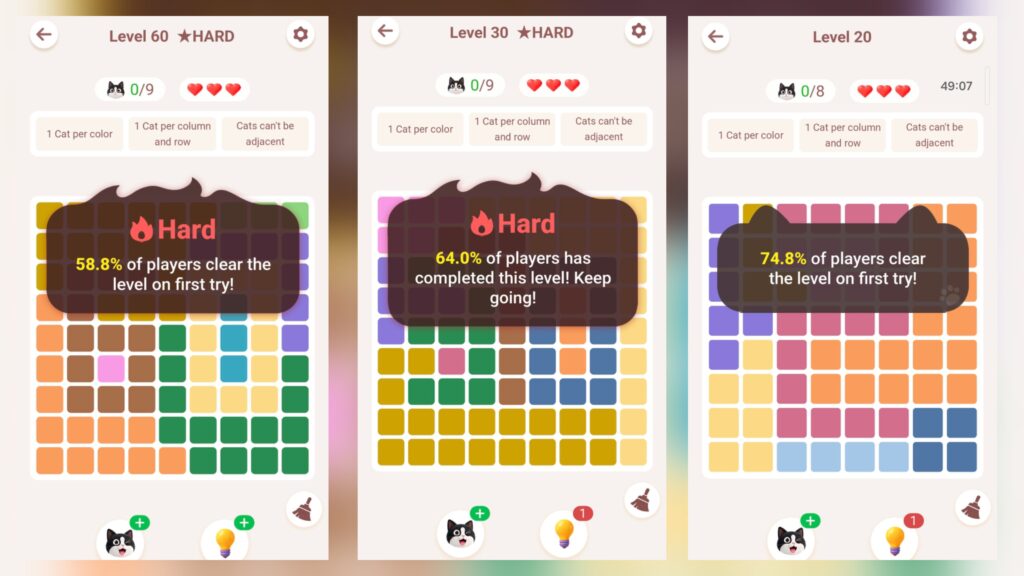
- Difficulty tiers: “Hard” levels (like Level 60) sit next to standard ones. You know when you’re stepping up.
- Stat tracking: “58.8% of players clear this level on first try”. That’s a soft leaderboard replacement — you measure yourself against the average.
- Daily Challenge: 11-hour timer gives you one fresh puzzle per day. Low pressure, high routine.
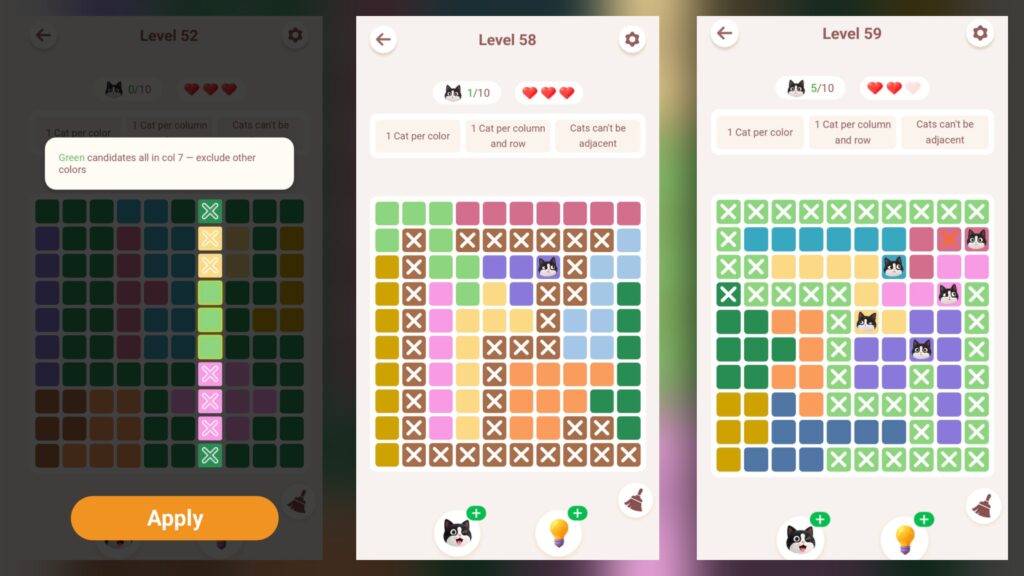
- Progress visibility: Level counts (20, 30, 52, 59) and clear markers (0/8, 0/9, 5/10) keep you moving.
What’s missing? No level packs, no prestige mode, no endless replay. Once you finish, you’re done. But for a pure puzzle game, that’s okay.
3. Empowerment & Creativity (9/10)
This is Meowdoku!’s killer feature.
No timers. No pay-to-win. No random luck. You get three resources:
- Logic — figure out where each cat goes.
- “X” markers — click to mark cells you’ve ruled out.
- Hint bulbs — optional help when you’re stuck.
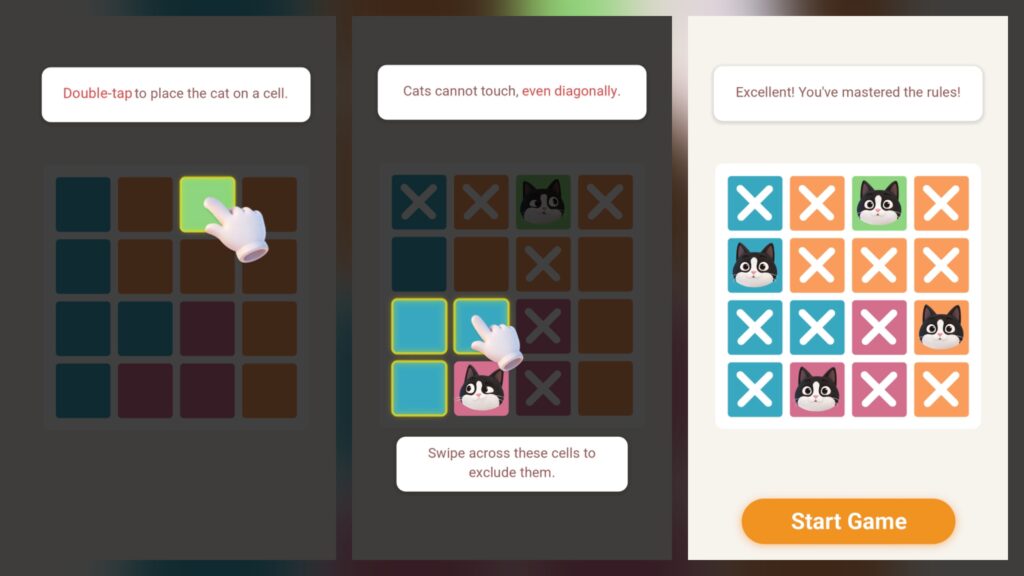
Rules stack naturally. Start with basic “one cat per row and column”【5.jpg】, then add “one cat per color”【6.jpg】, then “cats can’t be adjacent”【7.jpg】. Each new layer demands deeper reasoning without changing the core experience. That’s great onboarding.
The “Apply” button shown in one screenshot confirms players can test constraints before committing. No penalty for thinking — just pure puzzle solving. This is Empowerment done right.
4. Ownership & Possession (4/10)
What can you own?
- Your solved level list.
- Your star counts (implied by clear markers).
- Your best-first-try bragging rights (58.8% first-try stats).
What you can’t own: skins, hats for cats, custom boards, unlockable themes, collectibles. Nothing. This is not a collecting game. Ownership is purely about your achievement history. That’s fine for purists, but it leaves a layer of long-term attachment on the table.
5. Social Influence & Relatedness (3/10)
You play alone. No Facebook friends to beat. No co-op. No sharing solved puzzles. No global leaderboards — just those static first-clear percentages.
The trade-off: zero toxicity, zero social pressure. You never feel bad because your friend cleared Level 60 faster. But you also never feel the joy of sharing a tough solve. This is a deliberate design call — keep Meowdoku! chill and solitary — but it sacrifices the retention power of social hooks.
6. Scarcity & Impatience (6/10)
Instead of a ticking clock, Meowdoku! uses a heart system. You start with three. Wrong move loses one heart. Run out and you face an “Out of Hearts” screen — then revive or restart.
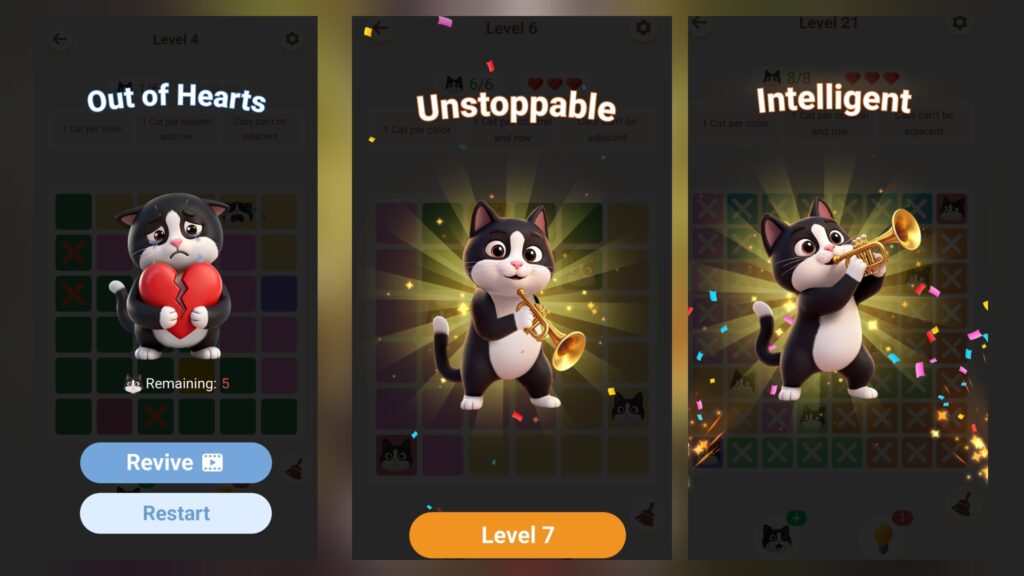
Why not a lower score? Because there’s no spin economy, no forced waits. No “buy more hearts” shoved in your face. The heart system exists to prevent brute-force guessing, not to extract money. It’s Scarcity as a teaching tool, not a monetization lever. That’s refreshing.
7. Unpredictability & Curiosity (7/10)
Meowdoku! doesn’t rely on gambling hooks or loot boxes. Its “unpredictability” is structural:
- Each level has a fresh layout.
- The rule sets evolve as you climb — Level 20 has 3 constraints, Level 60 has all 4.
- “Hard” appears unpredictably — Level 20, 30, 60 all carry the tag.
You never know exactly what the next puzzle looks like. That curiosity keeps you playing. It’s not explosive — no jackpots, no random rewards — but it’s steady and satisfying.
8. Loss & Avoidance (5/10)
Meowdoku! is gentle when you mess up.
Losing a heart? You’ve got two more. Lose all three? You can restart without harsh penalty. No paywalls. No “watch ad to continue” demands. No irreversible consequences.
Why the medium score? Because Avoidance drives are typically about fear — fear of losing progress, fear of missing out, fear of wasting resources. Meowdoku! has very little of that. It’s not designed to make you anxious. That’s a feature for some players, a missing retention lever for others.
Conclusion
Meowdoku! knows exactly what it is: a polished, adorable, medium-difficulty logic puzzle game. No bloat, no tricks, no slot machines. Just cats and grids.
At under 100MB and zero intrusive monetization, it’s worth a download for puzzle fans who miss when mobile games were just games.
This analysis is based on the genuine gameplay experience of the 09GameReview team and the Octalysis framework. The review is neutral and provided for reference. Search for Meowdoku! on Google Play.
Review Evidence and Sources
- Primary evidence: the gameplay recording and original screenshots embedded in this review.
- Meowdoku official Google Play listing, checked July 23, 2026.
- Octalysis framework tool, used as the structure for our editorial scoring.
If a material game update changes this review, we will add a dated correction or retest note.
Leave a Reply