
Jewel Coloring launched in February 2026 and quickly climbed to #1 on the iOS free charts in 14 countries, including the US and Japan. Developed by Ta Ta Game Technology, this pixel art puzzle game is racked up over 5 million downloads with a 4.8-star rating from 70,000+ reviews. On paper, it’s a hit.
Quick Verdict and Test Basis
- Test basis: at least 30 minutes of recorded hands-on play; the uncut gameplay segment and screenshots on this page are primary evidence.
- Best for: Players seeking a low-pressure sorting loop and gradual pixel-art completion.
- Watch for: Small gems, similar colours and limited zoom can create accessibility and visibility problems.
- Verdict: A calm completion loop with appealing reveals, held back by interface accessibility rather than puzzle ideas.
- Review updated: July 23, 2026. Store ratings, prices, downloads, events and ad frequency may change by version or region.
Our scores are editorial judgments, not scientific measurements. See the Editorial Policy for testing, sourcing, corrections and commercial disclosure rules.
But numbers don’t tell the whole story. I’ve taken this pixel art puzzle game for a spin—all the way to Level 50, daily challenges unlocked, “Exhibition” page still a mystery. Here’s my honest take, broken down through Yu-kai Chou’s Octalysis Framework.
What Is Jewel Coloring?
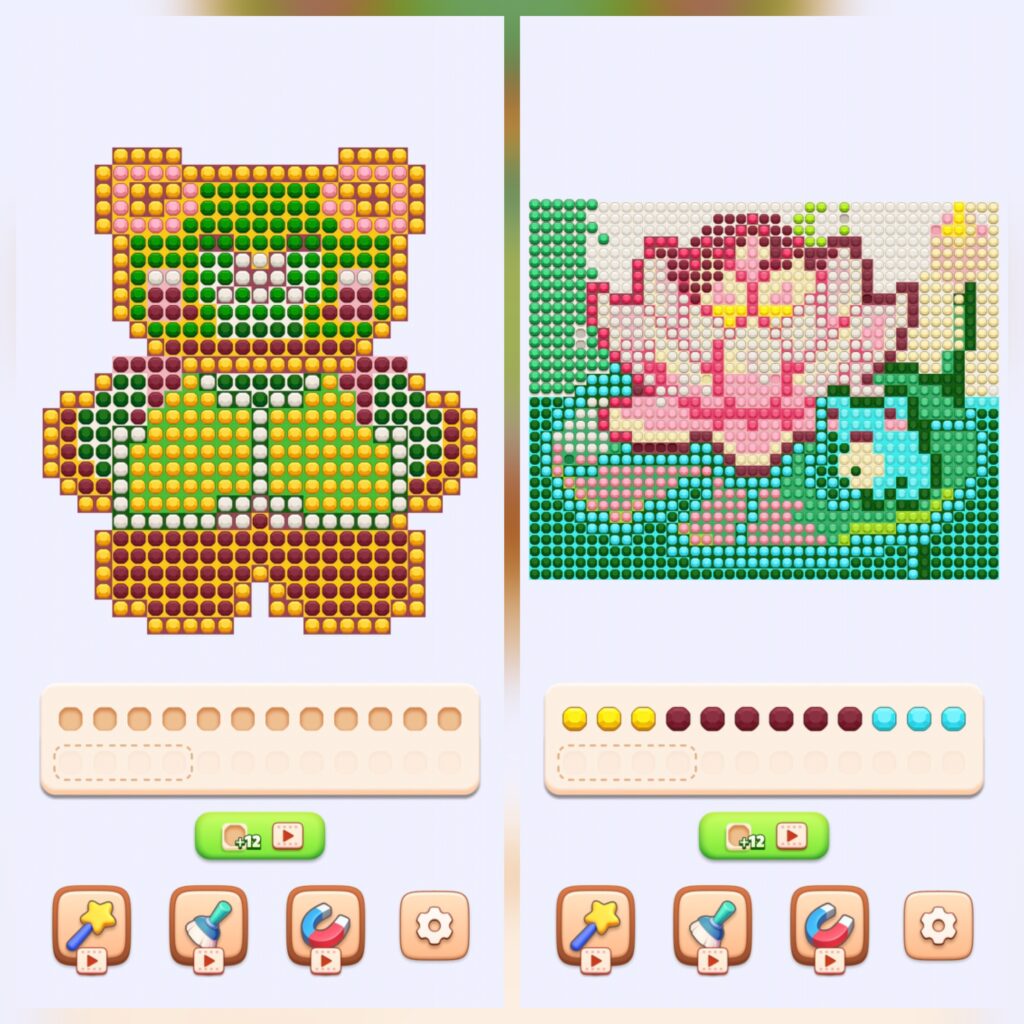
Basically, Jewel Coloring takes offline Perler Beads and puts them on your phone. You see a canvas with color slots. Your job? Sort scattered colored jewels back into their correct positions until reveal a hidden image. Think of it as digital diamond painting — the kind of craft that’s exploded in popularity worldwide.
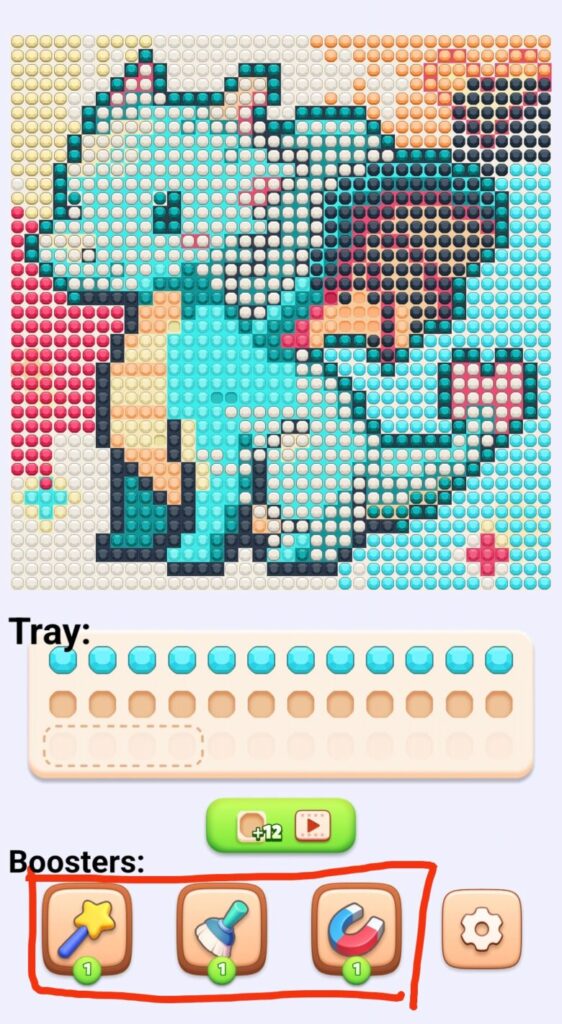
The catch: you can only hold a few gems at a time in a temporary tray at the bottom. Planning your moves matters. The puzzle is simple to learn but gets genuinely tricky as more colors and larger grids appear.
Sure, you can zoom in and out. But on a mobile screen? The gems are still tiny, and the colors are way too close to tell apart easily.
It’s fun and relaxing. Finishing a level feels good. But honestly, if you play too long, your eyes get really tired.
Octalysis Scorecard: Jewel Coloring
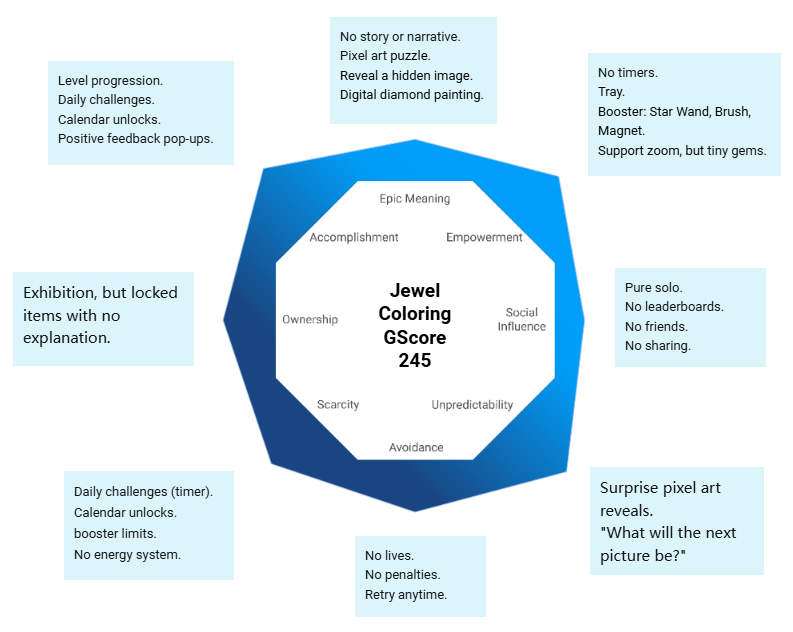
| Core Drive | Score (1-10) | Key Design Manifestations |
| Epic Meaning & Calling | 5 | Pixel art reveals — you’re “creating” art, but no story or narrative. |
| Development & Accomplishment | 7 | Level progression, daily challenges, calendar unlocks, positive feedback pop-ups (“Awesome!”). |
| Empowerment & Creativity | 5 | No timers, free to think. Booster: Star Wand, Brush, Magnet. Zoom function, but tiny gems make planning frustrating. |
| Ownership & Possession | 6 | Pixel art gallery (Exhibition) — but locked items with no explanation. |
| Social Influence & Relatedness | 3 | No leaderboards, no friends, no sharing. Pure solo. |
| Scarcity & Impatience | 6 | Daily challenges (timer), calendar unlocks. No energy system. |
| Unpredictability & Curiosity | 7 | New pixel art designs each level. “What will the next picture be?” |
| Loss & Avoidance | 5 | No lives, no penalties. Retry anytime. Very forgiving. |
Evaluation Notes
Scoring range: 1–10. Higher scores reflect stronger implementation of the core drive and greater player motivation.
GScore (Gamification Score): Calculated using the Octalysis Framework tool.
Octalysis Radar Chart
Chart Shape Analysis: The radar shows a “three peaks side by side but overall flatter” shape. The game is more “evenly distributed” – no standout strengths, but no major weaknesses either (except Social Influence). Curiosity(7) and Accomplishment(7) lead the pack. Empowerment(5) and Avoidance(5) are below, suggesting room for improvement in strategic depth and retention mechanics.
Octalysis Detailed Analysis
1. Epic Meaning & Calling (5/10)
Minimal narrative. The “creation” aspect gives it a slight bump, but there’s no grand mission.
Jewel Coloring has no story here. No characters, no quest, no “save the kingdom.” Your mission is simple: sort jewels to reveal pixel art.
The “meaning” comes from the creative satisfaction of watching a picture come together. Each completed level reveals a cute design — animals, food, flowers. It’s like finishing a paint-by-numbers project.
You’re not building toward anything bigger. Just level after level of sorting.
2. Development & Accomplishment (7/10)
This is where Jewel Coloring almost nails it. Each level is a fresh puzzle, and difficulty scales nicely—more colors, bigger boards, trickier patterns. Clearing a tough level feels genuinely rewarding.
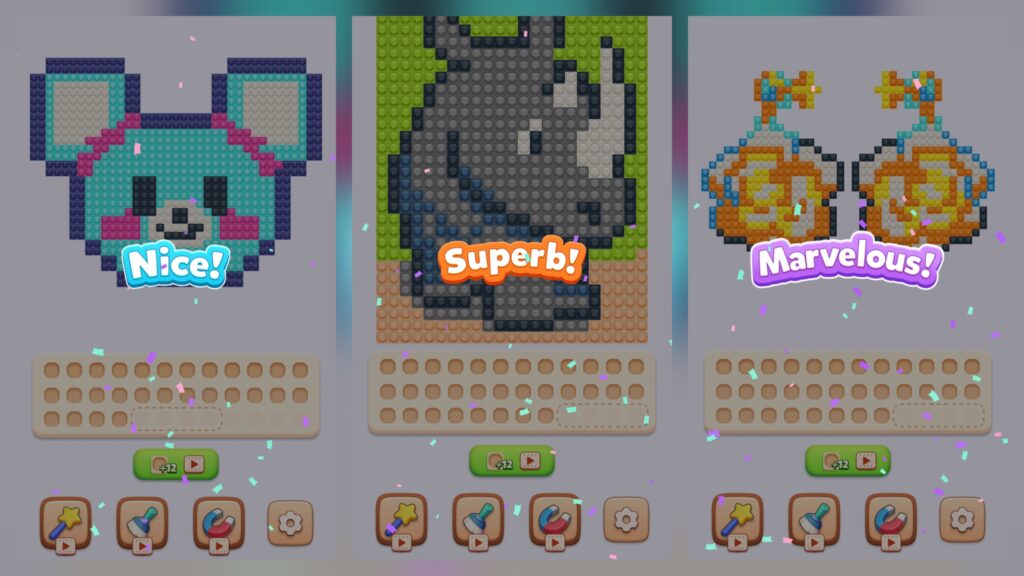
The game throws out “Awesome!”, “Outstanding!”, “Marvelous!” prompts when you finish. That’s a nice little dopamine hit.
One reviewer noted: “The gameplay is addictive because there’s always a goal and a strong sense of progress.”
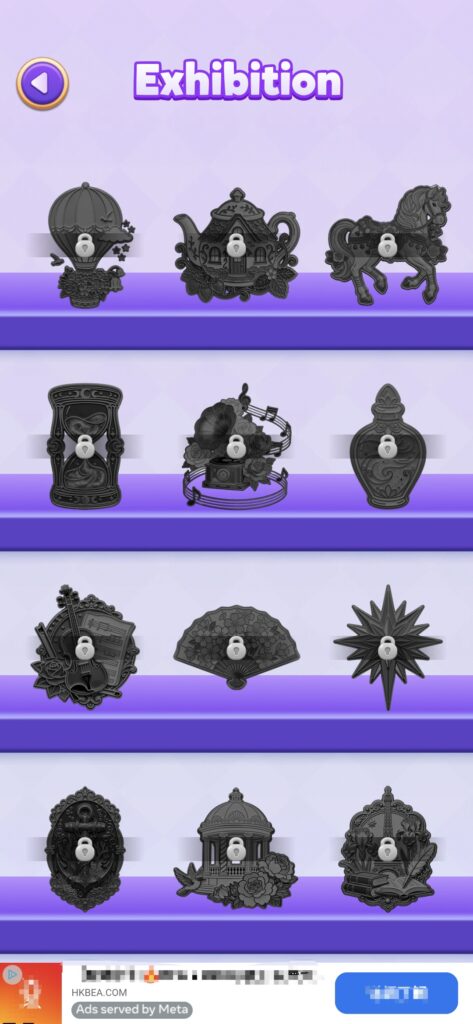
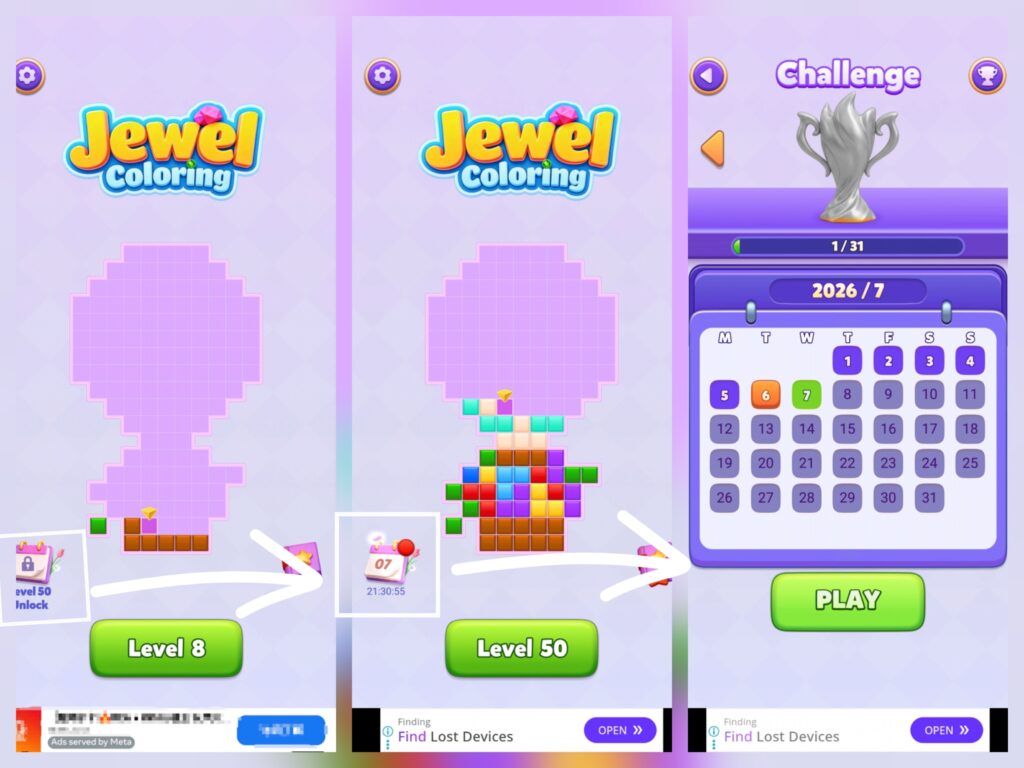
But the progression systems are undercooked. You unlock new levels, sure. At Level 50, daily challenges appear. But the Exhibition page—which looks like it should hold unlockable collectibles—stays completely empty with zero explanation. No stars per level. No score tracking. No mastery indicators. You finish a level and that’s it. Move on.
3. Empowerment & Creativity (5/10)
You don’t get much creative room here. Every gem has one correct slot. There’s no alternate color palette, no customization, no artistic choice. You’re following a pattern, not making one.
The feedback, though? Smooth. Gems snap into place with a satisfying shine. The pixel art fills in gradually as you sort, giving you constant visual progress.
But the visual design is a double-edged sword. The gems and color slots are tiny. Colors are often so similar you’re squinting to tell them apart. Yes, you can zoom in. But on mobile, that’s a pain—not a feature. Playing for more than 15 minutes genuinely strains your eyes.
One reviewer put it bluntly: “As you climb through the levels, the boards grow, the designs get detailed, and the color gradients turn subtle enough to make you second-guess yourself.”
The boosters help. The tray adds strategic flexibility. But the core visual design is still a strain on your eyes.
4. Ownership & Possession (6/10)
The game has an Exhibition section — a gallery where completed pixel art should be displayed.
But here‘s the issue: most items are locked. And the game doesn’t tell you how to unlock them. No explanation. No hint. Just “???”.
This is frustrating. You‘re creating art, but you can’t show it off or browse your collection properly. The ownership feels incomplete.
5. Social Influence & Relatedness (3/10)
No leaderboards. No friends. No sharing completed art. No “send a gift.” Nothing.
You‘re solving puzzles by yourself, for yourself. Some players love that isolation. Others will find it lonely.
6. Scarcity & Impatience (6/10)
Unlike most casual games, Jewel Coloring doesn’t have an energy system. No “5 lives, wait 30 minutes to refill.” You can play as long as you want.
What creates scarcity:
- Daily challenges have a 21:30:55 timer. Miss it? You lose that day‘s puzzle.
- Calendar rewards — miss a day? Lose that reward.
What’s missing:
- No energy system means no “come back later” pressure.
- No limited-time offers (at least not in the early game).
The game is surprisingly generous with your time. That‘s refreshing — but it also means fewer “must log in now” hooks.
7. Unpredictability & Curiosity (7/10)
This is the game‘s strongest drive.
- New pixel art each level. You never know what the next picture will be — an animal? A flower? A food item?
- Daily challenges add variety.
- New themes and collections are added regularly.
One player described it well: “Sorting feels surprisingly satisfying. The pixel art designs you’re ‘coloring’ are cute — and they slowly fill in as you sort.”
The curiosity isn‘t explosive — no loot boxes, no random rewards. But it’s steady. You keep playing because you want to see the next picture.
8. Loss & Avoidance (5/10)
This drive is barely present.
- No lives. You can‘t “lose” a level.
- No penalties. Restart anytime. No cost.
- No progress loss. You keep everything.
The game doesn’t punish you. It doesn‘t threaten you. It doesn’t create anxiety.
For some players, that‘s a huge plus. For others, it means fewer reasons to keep coming back.
Conclusion
The radar chart reveals a honest picture: Jewel Coloring is a game that “attracts well upfront, but struggles to retain long-term.”
Its competitive edge lies in “a new pixel-art picture every level” (Unpredictability) and “completing a picture” (Epic Meaning) – these two dimensions are why it cracked the top 10 in 50+ countries.
But the weaknesses are equally clear: near-zero social features, strategy hidden by visual issues, ownership that doesn’t feel real, and weak avoidance mechanics. A GScore of 245 suggests significant room for improvement in long-term retention and deep engagement.
If the developer can fix the three accessibility issues – gems are too small, colors are too similar, you can’t zoom – and make the “Exhibition” gallery actually work, GScore could easily break 300.
This review is based on real gameplay (up to Level 50) and the Octalysis Framework by Yu-kai Chou. Commercial relationships, if any, are disclosed under our Editorial Policy. Search for Jewel Coloring on Google Play.
Review Evidence and Sources
- Primary evidence: the gameplay recording and original screenshots embedded in this review.
- Jewel Coloring official Google Play listing, checked July 23, 2026.
- Octalysis framework tool, used as the structure for our editorial scoring.
If a material game update changes this review, we will add a dated correction or retest note.
Leave a Reply