

Merge, cook, travel, repeat — but watch that energy bar.
Quick Verdict and Test Basis
- Test basis: at least 30 minutes of recorded hands-on play; the uncut gameplay segment and screenshots on this page are primary evidence.
- Best for: Merge-game fans who enjoy collection, cooking themes and long-form progression.
- Watch for: Energy limits and inventory pressure sharply restrict uninterrupted sessions.
- Verdict: A polished merge journey with strong collection goals; energy remains the clearest long-term friction.
- Review updated: July 23, 2026. Store ratings, prices, downloads, events and ad frequency may change by version or region.
Our scores are editorial judgments, not scientific measurements. See the Editorial Policy for testing, sourcing, corrections and commercial disclosure rules.
Tasty Travels: Merge Game is the latest hit from Century Games, the studio behind the merge-2 phenomenon. It’s a culinary-themed merge game where you combine ingredients, complete tourist orders, and unlock travel destinations from Paris to Tokyo.
Sounds great, right?
It is — until the energy runs out.
I’ve played through the early levels, hit the energy wall, and learned exactly how this game hooks you (and where it trips). Here’s my breakdown using the Octalysis Framework — the gold standard for understanding player motivation.
The Core Loop (Quick Context)
Before we dive into the eight drives, here’s how Tasty Travels plays:
- Tap spawners → they produce basic ingredients (costs energy)
- Merge two identical items → create a higher-level item
- Complete customer orders → submit required items for coins and XP
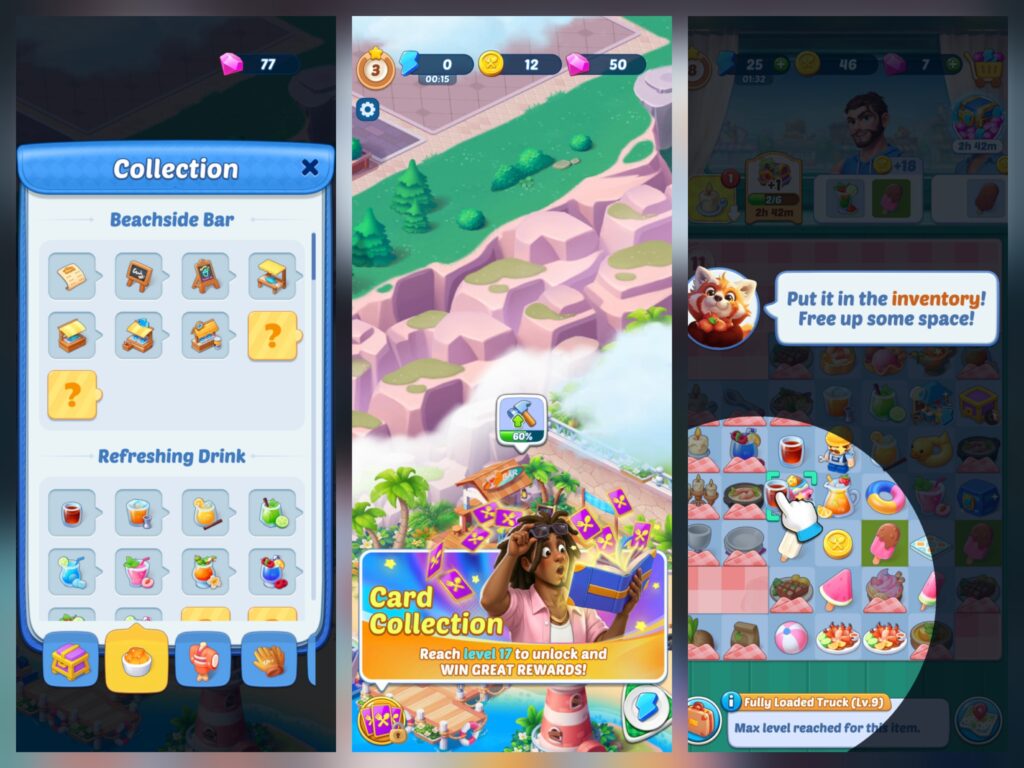
- Reach Level 17 → unlock the card collection system for great rewards
- Sell inventory items → exchange unwanted items for coins
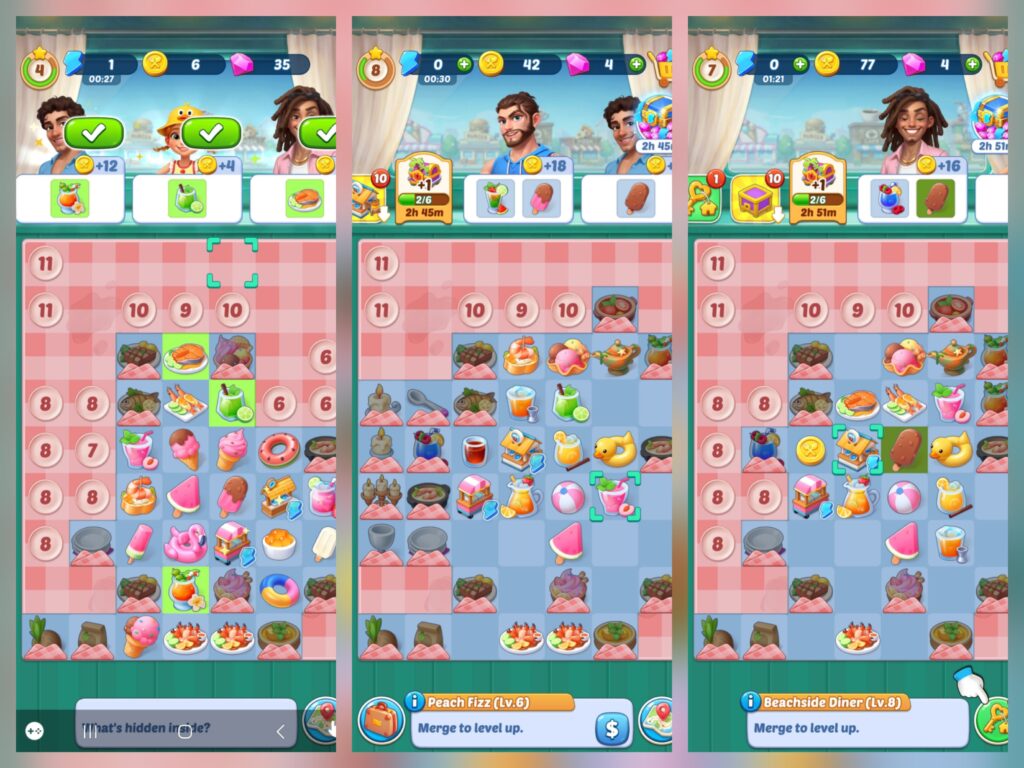
The game has over 500 unique ingredients to discover. You travel through culinary capitals like Paris and Tokyo. The world traveler theme gives you a reason to keep merging – you’re not just unlocking items, you’re unlocking new cities.
Now let’s look at the eight core drives.
Octalysis Scorecard
| Core Drive | Score (1-10) | Key Takeaway |
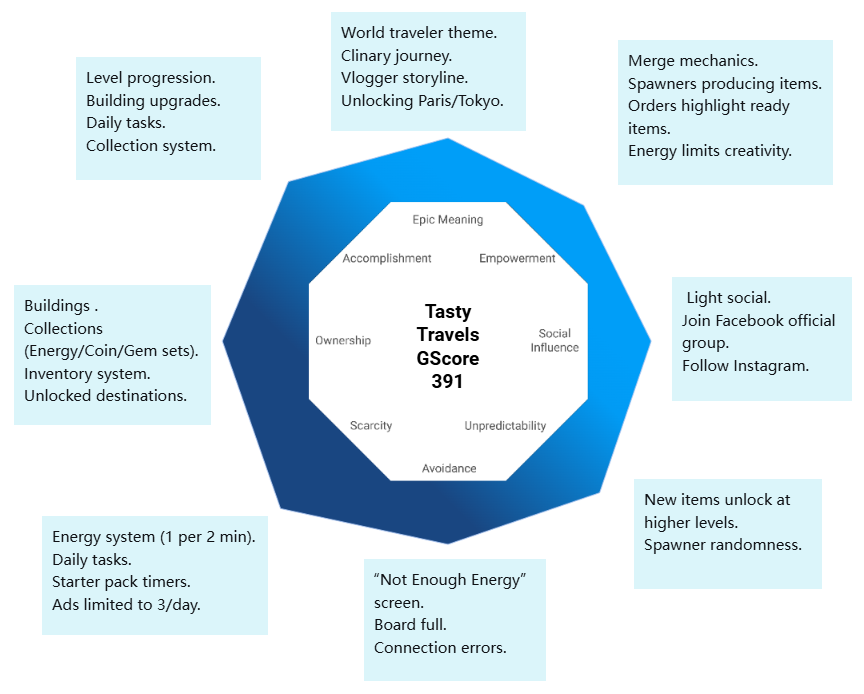
| Epic Meaning & Calling | 6 | Travel theme gives purpose. Light narrative, but enough. |
| Development & Accomplishment | 8 | Multiple progression systems. Always a goal to chase. |
| Empowerment & Creativity | 5 | Simple merge mechanics. Selling adds limited strategic choice. |
| Ownership & Possession | 8 | Buildings, items, cards – plus sellable inventory for liquidity. |
| Social Influence & Relatedness | 6 | Join official communities for diamonds. Light but rewarded. No in-game leaderboards or clubs. |
| Scarcity & Impatience | 9 | Energy system is the main monetization driver. Brutal but effective. |
| Unpredictability & Curiosity | 7 | New destinations, items, and events keep it fresh. |
| Loss & Avoidance | 6 | FOMO through dailies and limited offers. No harsh penalties. |
Evaluation Notes
Scoring range: 1–10. Higher scores reflect stronger implementation of the core drive and greater player motivation.
GScore (Gamification Score): Calculated using the Octalysis Framework tool.
Octalysis Radar Chart
The radar shows a game built around Scarcity and Ownership, with solid Accomplishment. Empowerment, Meaning and Social are weaker. The shape is right-brain heavy — emotional drives (scarcity, ownership) dominate over logical ones (empowerment, creativity). That’s typical for merge games, but the scarcity peak is unusually high.
Octalysis Detailed Analysis
- Epic Meaning & Calling (6/10)
This is where Tasty Travels shines compared to generic merge games. You’re not just merging random objects — you’re on a culinary journey around the world.
The game frames your progress as travel: unlock Paris, Tokyo, and other culinary capitals. Each destination has its own recipes and vibe. There’s even a storyline — you help a young vlogger uncover family secrets as she travels.
It’s not an epic fantasy quest, but it gives your merges context. You’re not just making a Tropical Fruit Drink (Lv.7) — you’re serving it to a tourist in a beachside bar.
- Development & Accomplishment (8/10)
This is where the game shines.
Every action gives you feedback:
- Merge two items → new item pops up
- Complete an order → “Awesome!” or “Fantastic!” pop-up + coins + XP
- Level up → new features unlock + rewards
- Upgrade a building → visual change on your map

The game uses multiple progression systems:
| Progression System | What It Does |
| Level progression | Each level unlocks new content |
| Building upgrades | Invest coins to improve facilities |
| Destination unlocks | Travel to new culinary cities |
| Card collection | Complete sets for rewards (unlocked at Level 17) |
One player put it perfectly: “The gameplay is addictive because there’s always a goal and a strong sense of progress.”
- Empowerment & Creativity (5/10)
Tasty Travels is a Merge-2 game – you merge two identical items to create a higher-level item. Spawners produce basic items.
When a customer orders something, the board highlights all ready items in green. No hunting. Just tap and go.
But the strategy is minimal:
- Which orders should you prioritize?
- Should you merge up to a high-level item or fulfill multiple smaller orders?
- How do you manage your limited board space?

The item sell feature does add strategic – should you keep items for higher merges or sell them for coins right now? That trade-off gives you at least a sliver of economic decision-making.
The real limitation is board space. Items take up grid slots, and once your board is full, you can’t spawn more items. You’re forced to merge, submit orders, or sell items to free up space. This creates pressure, but it also limits creative freedom.
- Ownership & Possession (8/10)
Tasty Travels gives you plenty to own:
- Buildings – unlocked and upgraded structures on your map. Each upgrade changes the visual and unlocks new features.
- Items – over 500 ingredients and dishes to discover.
- Cards – a collection system unlocked at level 17. Complete sets for big rewards.
- Spawners – produce items, upgradeable for better drops.
- Inventory – sell unwanted items for coins. Everything has a floor price.
The building system is particularly satisfying. Each building has multiple levels (e.g., Beachside Bar Level 4/6), and upgrading them requires specific resources.
The selling feature makes ownership feel more real. You can actively manage your assets.
- Social Influence & Relatedness (6/10)
Social features exist but they’re thin.
However, there’s a clever hook in the Settings page – a “JOIN US!!” button. Tap it, and you’re guided to join the official Facebook group and Instagram. First-time joiners get diamond rewards for each platform.
This is smart. It uses in-game currency (Diamonds) to drive external social engagement. Players who want free premium currency now have a reason to follow the game on social platforms.
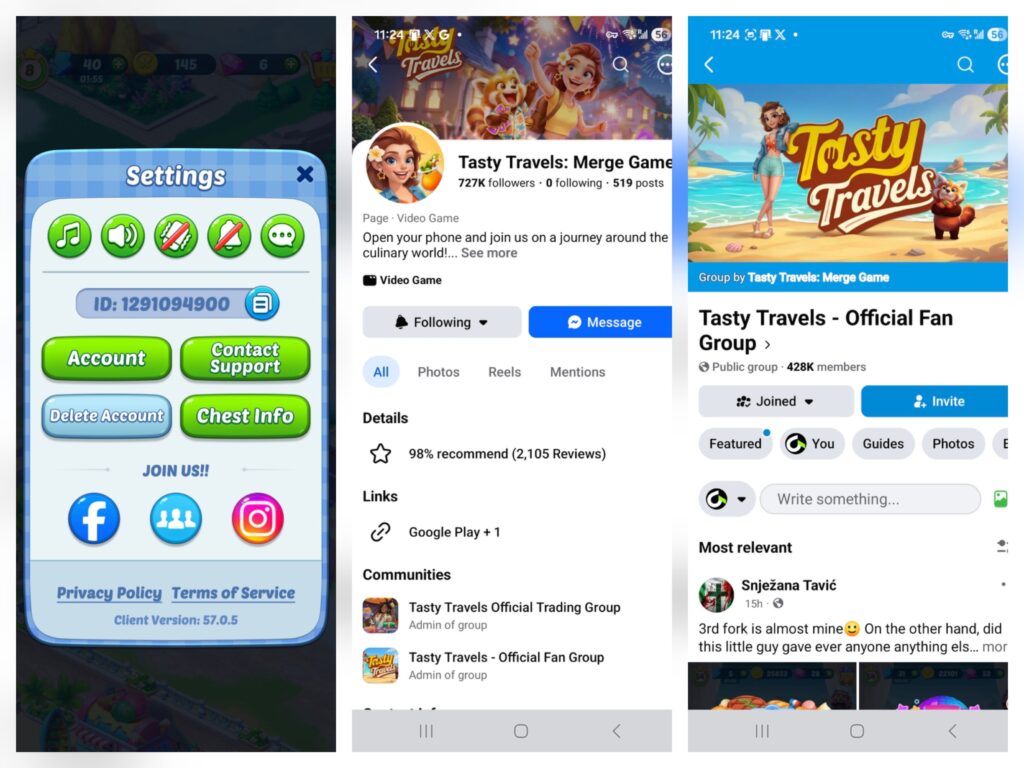
But it’s still light:
- No friend leaderboards
- No real-time PvP or co-op
- No life-sending or mutual-help systems
The social drive exists, but it’s one-way: you engage outside the game, you get rewards inside the game. It’s effective for building a community, but it doesn’t create ongoing social pressure or collaboration.
- Scarcity & Impatience (9/10)
This is the game’s dominant drive — and its biggest frustration.
Energy system: 1 energy restores every 2 minutes. Spawning items costs energy. Run out? Three options:
- Wait (2 minutes per energy — slow)
- Pay (gems or real money)
- Watch an ad (30–40 seconds, but limited to 3 times per day)
Daily tasks have timers. Miss them? Lose rewards.
Starter packs have countdowns. FOMO is real.
Players confirm this:
“First few levels are nice and very addictive and then you run out of energy so fast you can’t even play.”
“It requires a lot of time for you to complete one order, very low energy… The game basically wants you to pay money for you to play.”
This is classic scarcity design. The game hooks you with easy, rewarding early levels, then tightens the energy leash. You’re constantly running low, constantly wanting “just a little more energy” to finish order.
- Unpredictability & Curiosity (7/10)
The game keeps you curious about:
- New items: “Reach Level 7 to unlock this item”. You want to see what’s next.
- Spawner variety: Different spawners produce different items.
- New destinations: Paris, Tokyo, and more.
But the core loop is predictable. Merge. Order. Upgrade. Repeat. No random loot boxes, no gacha. The curiosity is progressive (what’s the next item?) not random (what’s in the box?).
- Loss & Avoidance (6/10)
Tasty Travels relies more on opportunity loss than on punishment for failure. Features like daily tasks, limited-time offers, and card collections are all FOMO-driven mechanics — they push you to log in and act before you miss out.
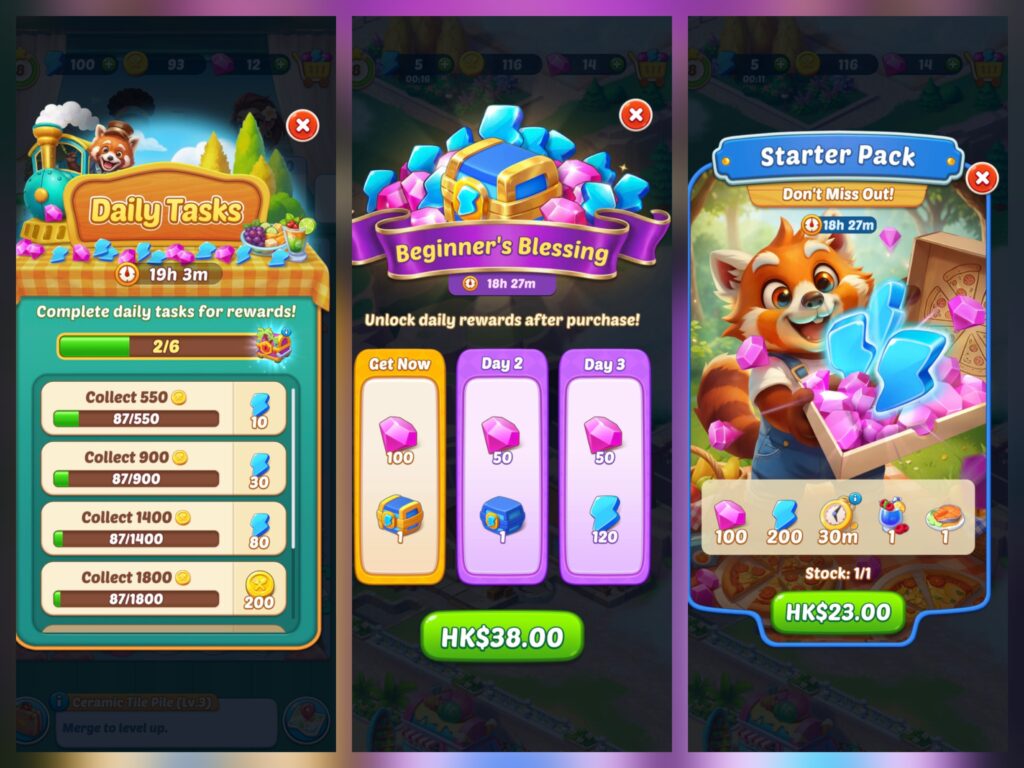
The energy system creates a subtle form of loss aversion. If you’re not using your energy, you’re effectively wasting its regeneration speed. This nudges you to open the app frequently and spend energy before it hits the cap.
The selling system also taps into a “don’t lose value” mindset. Items sitting in your inventory take up space, so selling them for coins feels like a smart move — at least you’re getting something back. That’s loss aversion at work too.
Conclusion
Tasty Travels: Merge Game is a polished, gorgeous merge game that knows exactly what it is. It hooks you with travel-themed meaning, clear goals, and a cozy beach vibe.
But the energy system is the real gatekeeper — and it’s designed to make you open your wallet. The game has over 500 items to discover, daily events, and a storyline that gives your merges purpose. It’s one of the better merge games out there. But the energy wall is real — and it’s the main reason players quit.
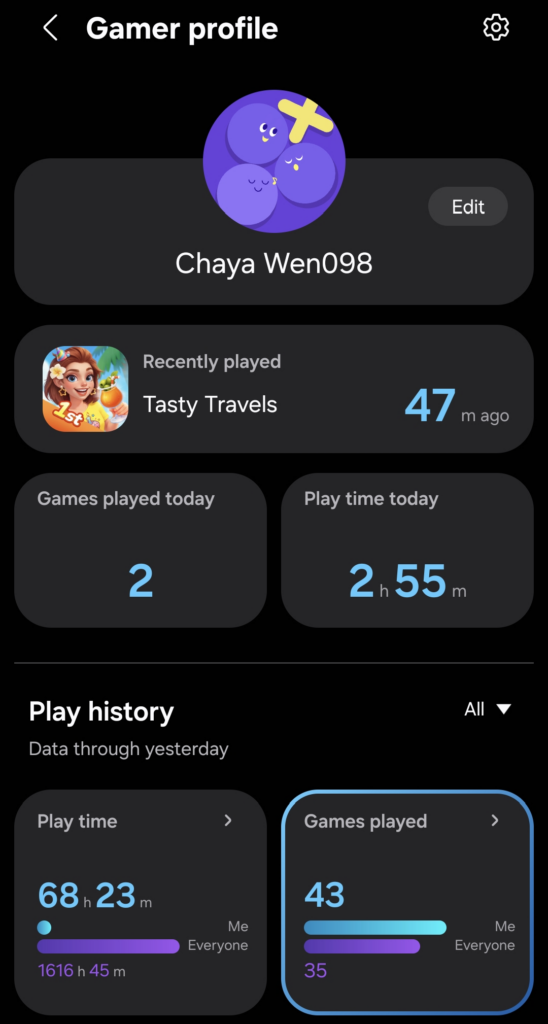
According to my playtime stats, I’ve spent over 68 hours on Tasty Travels, which puts me well above the average player. That gives me enough context to break down what actually works — and what doesn’t.
Review Evidence and Sources
- Primary evidence: the gameplay recording and original screenshots embedded in this review.
- Tasty Travels: Merge Game official Google Play listing, checked July 23, 2026.
- Octalysis framework tool, used as the structure for our editorial scoring.
If a material game update changes this review, we will add a dated correction or retest note.
Leave a Reply