
You’ve all played Snake, right? Now the classic Snake has a new coat. Snake Puzzle: Slither to Eat! is not the old arcade “eat and grow longer.” It’s a puzzle version: draw a path for your snake, eat apples, drumsticks, and other food, avoid obstacles, and finally enter the portal to clear the level. Levels aren’t all shown at once – you unlock them one by one. Difficulty changes, obstacles vary. Ads exist but aren’t overbearing. The puzzle flavor is strong.
Quick Verdict and Test Basis
- Test basis: at least 30 minutes of recorded hands-on play; the uncut gameplay segment and screenshots on this page are primary evidence.
- Best for: Players who like route planning, compact levels and a mix of puzzle and retro score modes.
- Watch for: Hints, skips, events and leaderboards add retention pressure around a simple core loop.
- Verdict: A balanced route puzzle whose progression and scarcity systems do most of the motivational work.
- Review updated: July 23, 2026. Store ratings, prices, downloads, events and ad frequency may change by version or region.
Our scores are editorial judgments, not scientific measurements. See the Editorial Policy for testing, sourcing, corrections and commercial disclosure rules.
The challenge in Snake Puzzle: Slither to Eat! is: limited space, only up/down/left/right movement, and obstacles around. Take a wrong turn and you either block yourself or get hurt by obstacles.
I’ve played quite a few levels, used hints, skipped a few times, and collected some limited skins. Now let’s break it down using the Octalysis framework.
Octalysis Scorecard:
| Core Drive | Score (1-10) | Key Design Elements |
|---|---|---|
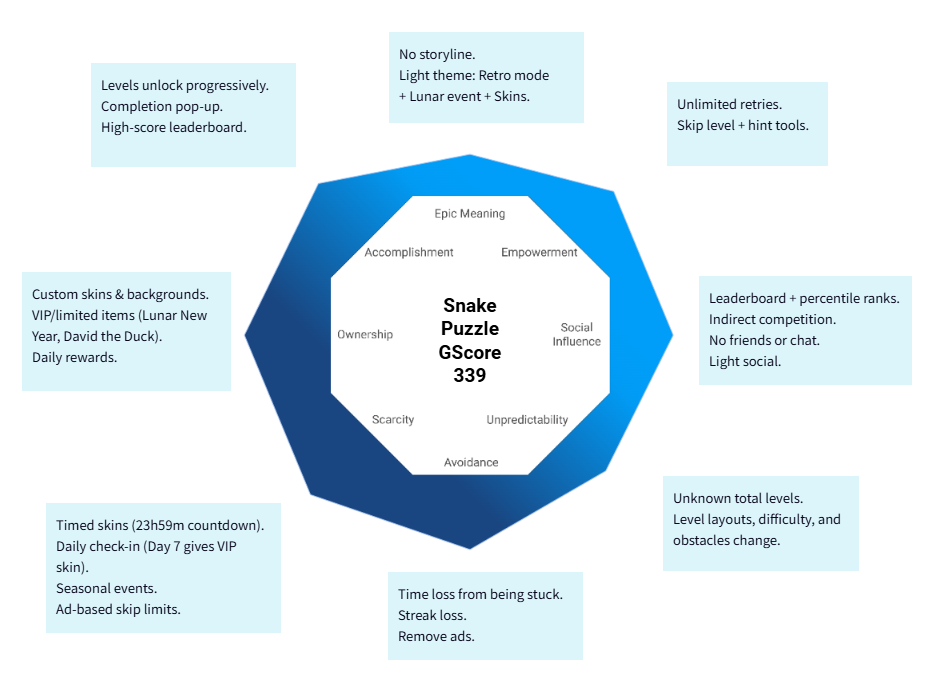
| Epic Meaning & Calling | 4 | No storyline. Retro mode + Lunar event + skins – light theme is enough. |
| Development & Accomplishment | 7 | Levels unlock progressively (total count hidden); completion pop-up (“better than X% of players”); high-score leaderboard. |
| Empowerment & Creativity | 6 | Unlimited retries for trial and error; skip level + hint tools require watching ads – freedom of strategic choice. |
| Ownership & Possession | 8 | Custom skins & backgrounds. VIP/limited items (Lunar New Year, David the Duck). Daily rewards. |
| Social Influence & Relatedness | 6 | Leaderboard + percentile ranks. Indirect competition – no friends or chat, light social enough. |
| Scarcity & Impatience | 8 | Timed skins (23h59m countdown), daily check-in (Day 7 gives VIP skin), seasonal events, ad-based skip limits – FOMO maxed. |
| Unpredictability & Curiosity | 5 | Unknown total levels. Level layouts, difficulty, and obstacles change, but no true random elements or surprise rewards. |
| Loss & Avoidance | 7 | Time loss from being stuck + streak loss drives active ad viewing. “Remove ads” IAP removes full-screen ads and banners. |
Evaluation Notes:
Scoring range: 1–10. Higher scores reflect stronger implementation of the core drive and greater player motivation.
GScore (Gamification Score): Calculated using the Octalysis Framework tool.
Octalysis Radar Chart
Chart interpretation: The radar shows an irregular shape that is “heavy on the right, light on the left; high in front, low in back” – like a boot tilting right. The left side (Epic Meaning, Unpredictability) is visibly sunken; the right side (Ownership, Scarcity, Accomplishment) bulges out. This indicates the game’s drives rely heavily on personal growth and collecting, not on narrative or social features.
In-Depth Core Drive Analysis
1. Epic Meaning & Calling (4/10)
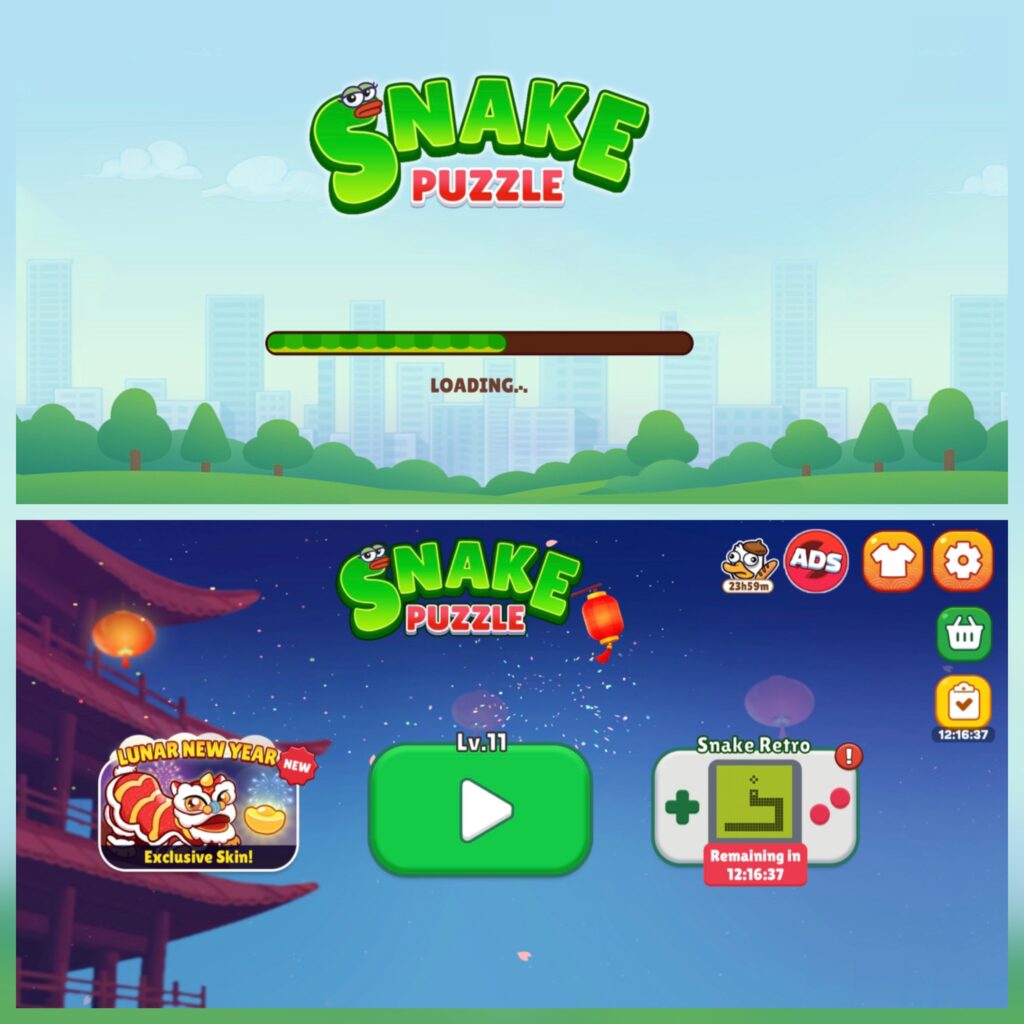
The game has no world-saving story. But the Lunar New Year event, classic retro mode, and limited skins give it a bit of ceremonial feel. The skin system lets you have your own little snake pet – a lightweight hook of meaning. It’s suited for “gameplay-first” casual players.
2. Development & Accomplishment (7/10)
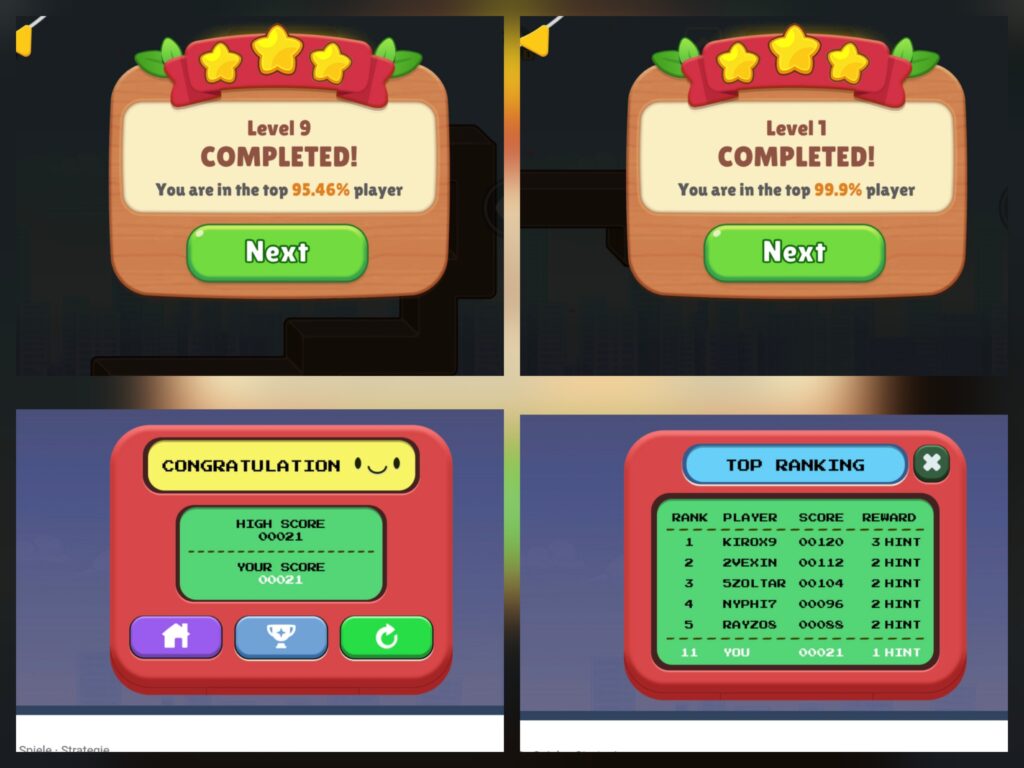
No level stars, and the achievement system is fairly linear. But every time you complete a level, you immediately get a “COMPLETED!” pop-up plus a percentile rank:
- “You are in the top 99.9% player”
- “You are in the top 95.46% player”
That single line makes you think: “Wow, I’m better than X% of players.”
Levels unlock infinitely – you never see the end, which makes you curious: “What does the next level look like?” Difficulty keeps changing, so each victory feels fresh. Also, the classic retro mode (Snake Retro) gives nostalgic players another track to chase high scores and records – a second achievement line.
Players have commented: “fun & addictive”, “easy to learn, hard to master” – no argument there.
In short, two parallel progression lines:
| Short-term feedback | Complete level → pop-up → satisfaction |
|---|---|
| Long-term goals | Daily check-in (Day 1–7), unlock skins, climb leaderboard (TOP RANKING) |
3. Empowerment & Creativity (6/10)
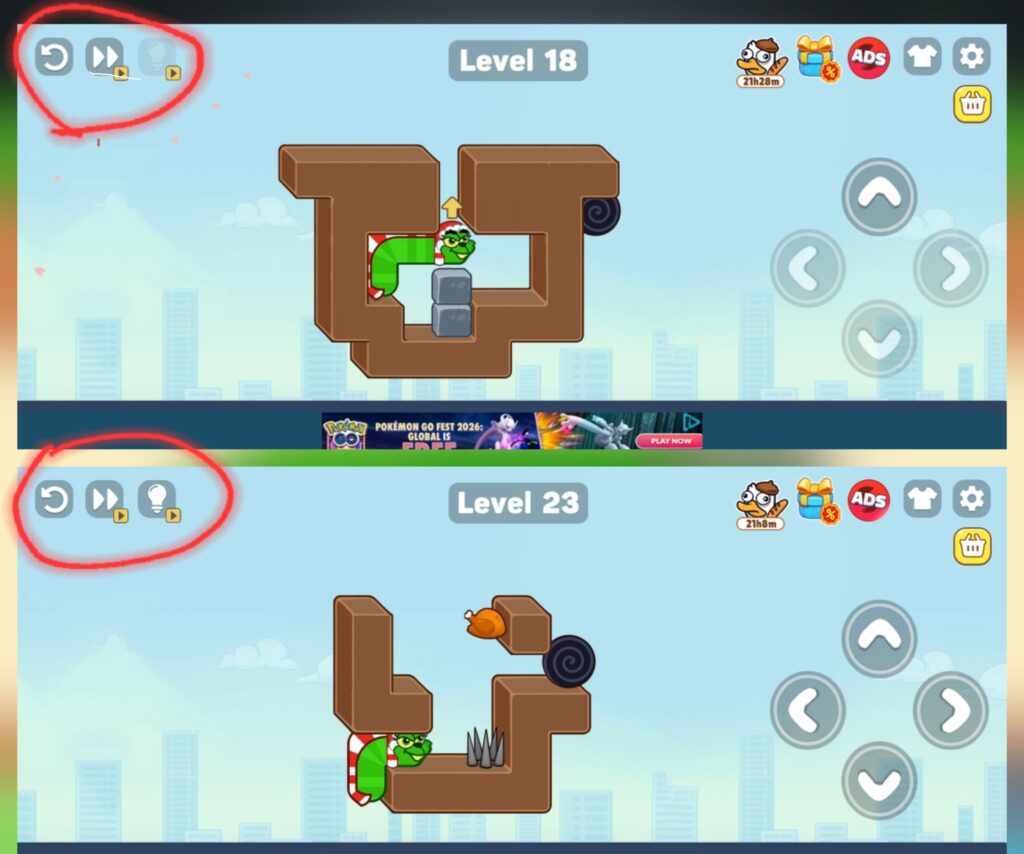
Snake Puzzle is not the frantic real-time Snake. It turns real-time dodging into turn-based planning – already fresh. When difficulty ramps up later, you may need hint tools to pass. This gives players a sense of control and choice.
The game’s three helper tools:
- Hint (earn by watching ads, daily check-in, or leaderboard rewards)
- Skip Level (lifesaver when stuck)
- Replay (practice)
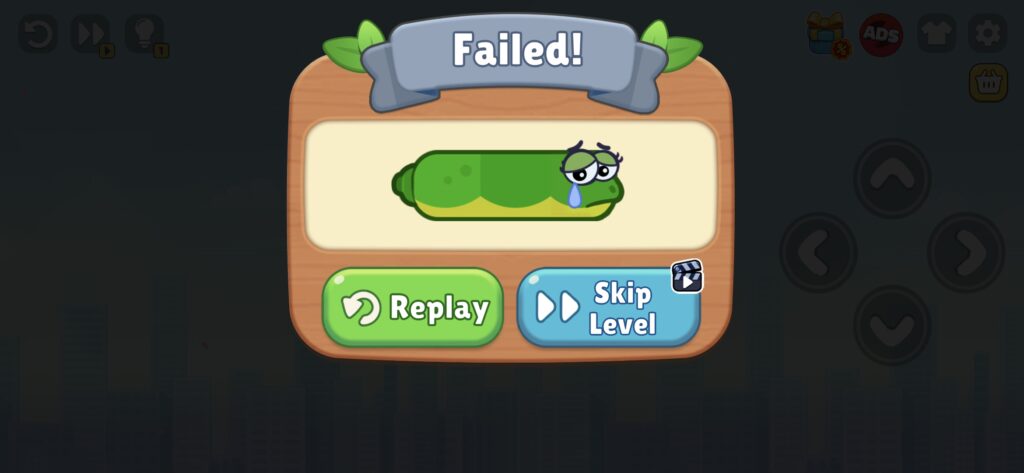
Also, unlimited retries on failure – no waiting. You never feel “no lives left, can’t play.” You can trial-and-error freely until you find the optimal path. This penalty-free experimentation space is exactly the empowerment puzzle games need.
4. Ownership & Possession (8/10)
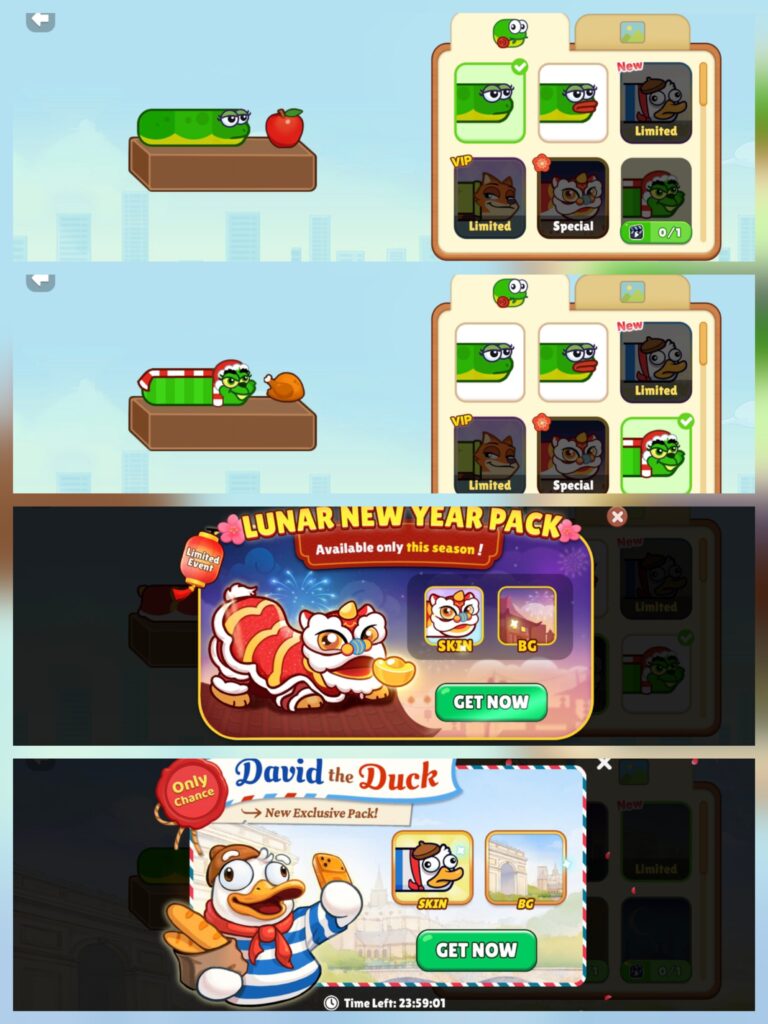
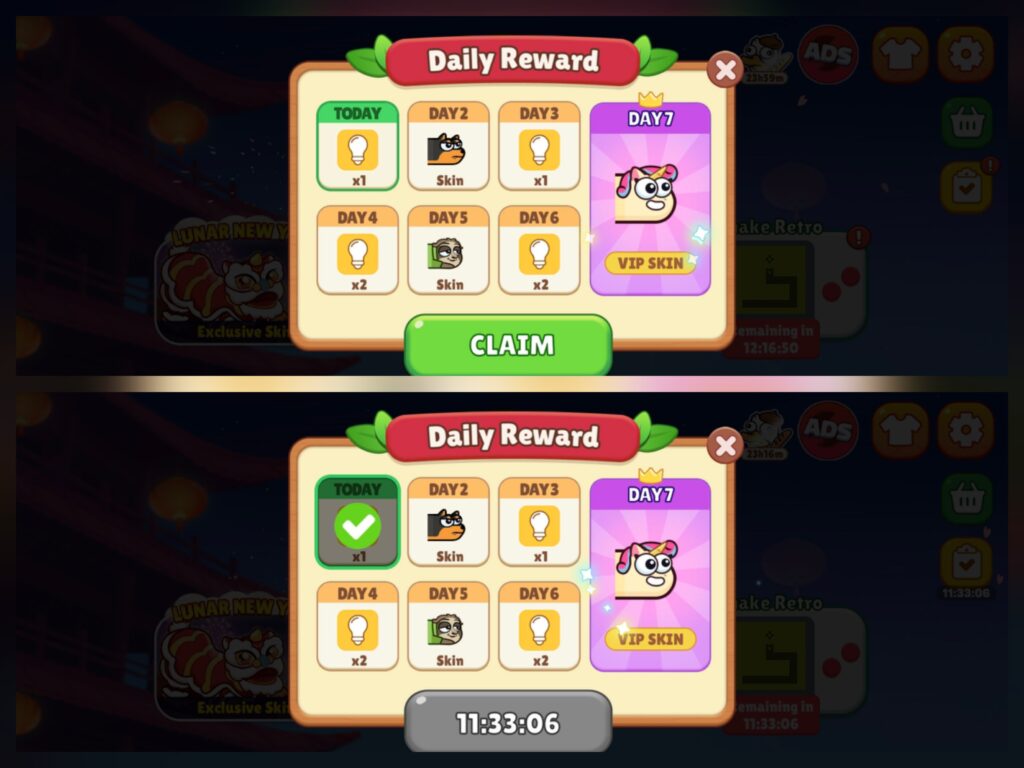
Custom skins and backgrounds make each snake feel like your own. VIP and limited/time‑limited events (e.g., Lunar New Year exclusive skins) have a “Limited” countdown – miss it, wait a year (“Available only this season!”). The daily reward calendar shows Day 1–7 with skins and multiplier items. Day 7 gives a “VIP SKIN”. For collectors, this hook is strong.
One player said: “The one-time fee to remove ads is reasonably priced.” Fair pricing actually makes ownership feel more real – you feel the money is well spent, so the skin feels even better.
5. Social Influence & Relatedness (6/10)
Snake Puzzle is not a heavy social game. But what’s there is enough:
- Global leaderboard in classic retro mode (TOP RANKING): shows player names and scores
- Rank rewards: 1st gets 3 hints, 2nd–5th get 2 hints, 11th gets 1 hint
- Percentile rank after each level – you can compare without adding friends.
6. Scarcity & Impatience (8/10)
Scarcity design is mature, effectively boosting daily activity and retention. Lunar New Year event countdown, daily check-in (Day 1–7), limited skins – all “miss it, lose it.” Even the “skip level via ad” mechanism creates scarcity: you only get skips by watching ads, so you don’t waste them. All of this builds urgency.
7. Unpredictability & Curiosity (5/10)
The unknown total level count itself is a hook! You never know how many levels there are. Unlocking a new level feels like opening a blind box. Later levels vary obstacles and layouts a lot – you’re always curious: “What will the next level throw at me?”
The classic retro mode and New Year event also add two extra doors to explore on the main screen. But the core gameplay is fixed; there’s no real “big surprise”. Randomness is weak, lacking gacha-like pulls or hidden Easter eggs that continuously fuel curiosity.
8. Loss & Avoidance (7/10)
The penalty is mild, more of a hidden driver. No energy system or forced waiting – failure allows unlimited retries. But time loss is the key. Getting stuck for too long wastes time, so players actively watch ads to skip or use hints to avoid inefficiency.
Also, breaking the daily check-in streak means losing a rare skin; dropping on the leaderboard means losing hint rewards – all classic loss aversion triggers.
One player noted: “It doesn’t shove ads down your throat at every opportunity, even after you progress pretty far.” Ads exist but aren’t abusive. This restraint actually makes loss aversion more effective – because when you fail, you feel it’s your own fault, not the game’s.
Conclusion
Snake Puzzle: Slither to Eat! is fairly balanced across the eight core drives. It abandons costly narrative and complex random systems, focusing its resources on the four dimensions that most directly drive retention and monetization: Ownership + Scarcity + Accomplishment + Loss Avoidance. The GScore of 339 proves this strategy works well in the free casual puzzle game space.
This analysis is based on the genuine gameplay experience of the 09GameReview team and the Octalysis framework. The review is neutral and provided for reference. Search for Snake Puzzle: Slither to Eat! on Google Play.
Review Evidence and Sources
- Primary evidence: the gameplay recording and original screenshots embedded in this review.
- Snake Puzzle: Slither to Eat official Google Play listing, checked July 23, 2026.
- Octalysis framework tool, used as the structure for our editorial scoring.
If a material game update changes this review, we will add a dated correction or retest note.
Leave a Reply