
A simple puzzle game with a hidden flaw that breaks the fun.
Quick Verdict and Test Basis
- Test basis: at least 30 minutes of recorded hands-on play; the uncut gameplay segment and screenshots on this page are primary evidence.
- Best for: Players who enjoy sequence planning and minimalist spatial puzzles.
- Watch for: Dense boards and limited visibility can make mistakes feel harder to diagnose than to solve.
- Verdict: A strong logical premise weakened when presentation and recovery systems get in the way of fair planning.
- Review updated: July 23, 2026. Store ratings, prices, downloads, events and ad frequency may change by version or region.
Our scores are editorial judgments, not scientific measurements. See the Editorial Policy for testing, sourcing, corrections and commercial disclosure rules.
In the world of mobile puzzles, Arrows – Puzzle Escape attracts players with clean visuals and a simple rule: slide arrows to the exit. No story. No social features. Just pure logic training.
Easy to learn, but as levels go on, difficulty jumps up fast. Then the cracks start to show. This game has potential, but a strange design choice – no zoom – keeps it from being great.
We‘ll use the Octalysis Framework to break it down. We’ll look at the game‘s design and real player experience. And we’ll focus on one big missing feature: you can’t zoom out. That one flaw acts like a poison pill, twisting the whole motivation loop.

Octalysis Scorecard
Below is a detailed evaluation of Arrows – Puzzle Escape across the eight core drives.
| Core Drive | Score (1-10) | Key Game Design Manifestations |
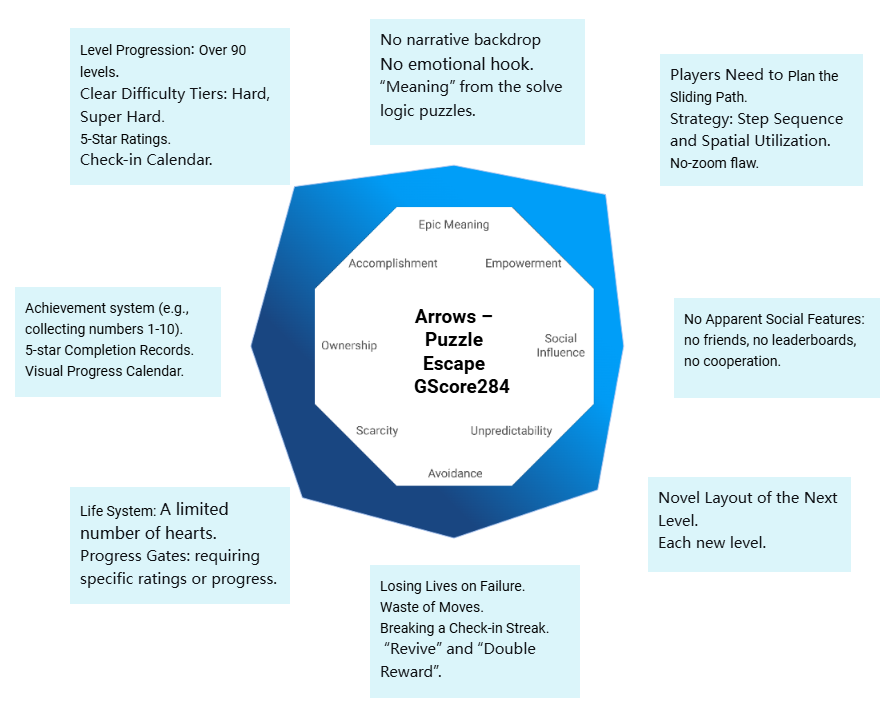
| Epic Meaning | 4 | Virtually no narrative backdrop. The core goal is abstract (guiding arrows to escape). Puzzle-solving for its own sake. |
| Accomplishment | 8 | Clear Core Progression: Numerous linear levels (at least 90), clear difficulty tiers (Hard, Super Hard), 5-star rating system, monthly check-in calendar. |
| Empowerment | 7 | Core gameplay requires players to plan the sliding path, finding the optimal solution within confined space. Strategy lies in step sequence and spatial utilization. |
| Ownership | 6 | Accumulating game assets through an achievement system (e.g., collecting numbers 1-10) and 5-star completion records. The visual progress calendar also enhances possession. |
| Social Influence | 3 | Based on available material, no apparent social features (e.g., friends, leaderboards, cooperation). A fully self-contained solo puzzle experience. |
| Scarcity | 7 | Heart-based life system (failure consumes hearts,耗尽 requires waiting), potential level unlock gates (requiring specific ratings or progress). |
| Unpredictability | 6 | Anticipation for the novel layout of the next level is the primary driver. Each new level is an unknown spatial puzzle to explore and solve. |
| Avoidance | 5 | The cost of losing lives on failure, potential waste of moves due to poor strategy, the sense of progress loss from breaking a check-in streak. |
Evaluation Notes:
Scoring range: 1–10. Higher scores reflect stronger implementation of the core drive and greater player motivation.
GScore (Gamification Score): Calculated using the Octalysis Framework tool.
Octalysis Radar Chart
The radar chart shows two high peaks: Accomplishment and Scarcity. That means the game relies a lot on level progress and resource limits (hearts).
But Empowerment is very low. Why? Because the zoom issue kills strategic planning. This creates a broken player experience.
In-Depth Core Drive Analysis
- Epic Meaning & Calling (4/10)
No story. No emotional hook. Your mission is just “slide arrows to the exit.” Good for pure logic lovers, but lacks deeper meaning or immersion.
- Development & Accomplishment(8/10)
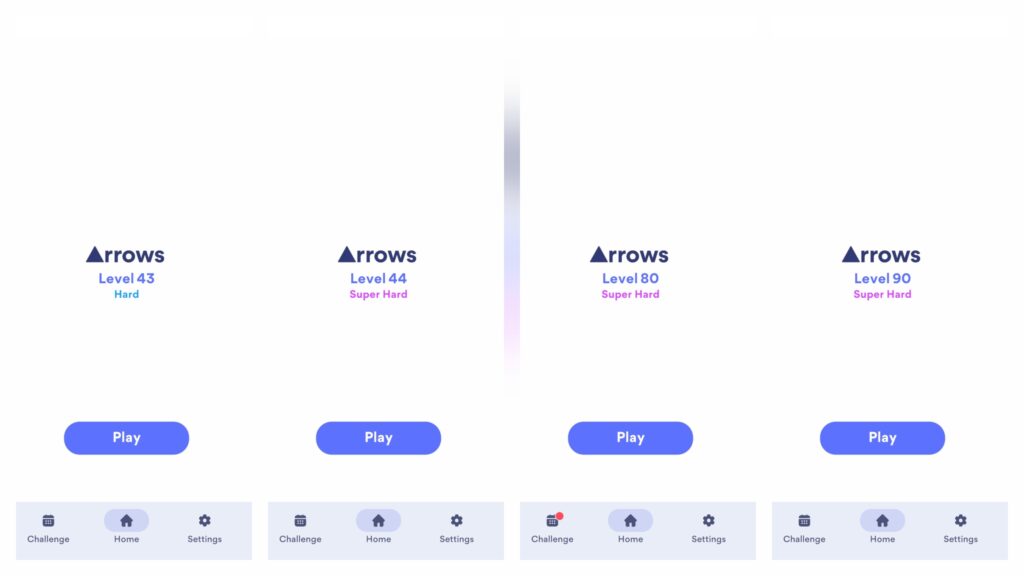
This is the game‘s strongest part. Many levels, “Hard” / “Super Hard” labels, 5-star ratings, and a monthly check-in calendar. Short-term goals (next level) and long-term goals (perfect all levels).
But the difficulty curve is uneven. And mis-taps (from no zoom) cause unfair failures. That hurts the sense of accomplishment.
- Empowerment & Creativity (7/10)
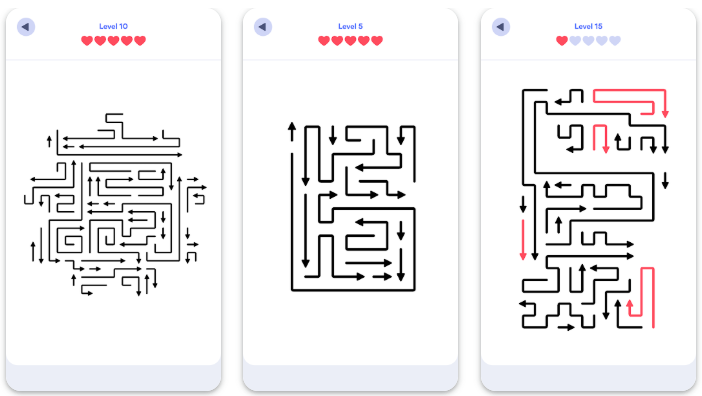
The core is spatial planning. That can be deep. But the no-zoom flaw takes away your ability to see the whole map. On complex levels, you have to guess and tap blindly. Mis-taps are common. Strategy becomes frustration. This flaw breaks the positive feedback loop.
- Ownership & Possession(6/10)
Two main sources of ownership:
- Achievements (collect numbers 1–10) – trackable goals.
- 5-star records – proof of your skill and time.
It works, but the frustrating process of getting those stars lowers their value.
- Social Influence & Relatedness(3/10)
Pure solo. No friend leaderboards, no co-op. Good for quiet thinking time. Bad when you‘re stuck – no help, no community push.
- Scarcity & Impatience(7/10)
Limited hearts (lives) create scarcity. Classic design. Ads offer a way to trade attention for another try – fair in theory.
But the no-zoom flaw makes you lose hearts faster than you should. You’re not failing because you‘re bad at puzzles. You’re failing because the interface is bad. That turns scarcity from a fair challenge into an annoying bottleneck.
- Unpredictability & Curiosity(6/10)
Curiosity about the next level layout is a real driver. “What does Super Hard Level 44 look like?” That keeps you tapping “Next.”
But the core mechanic never changes (always slide arrows). Over time, that curiosity fades.
- Loss & Avoidance(5/10)
Standard negative drives:
- Avoid losing lives → play more carefully.
- Keep your check-in streak alive → log in daily.
Nothing special. But again, the zoom flaw makes losses feel unfair, not earned.

Conclusion
Arrows – Puzzle Escape has a broken motivational loop.
The main problem: Poor Empowerment (no zoom) hurts fair Accomplishment and makes Scarcity feel unfair. It also forces you into the ad loop more often than needed.
The ad model is clear in theory: watch an ad to save progress. But in reality, you’re watching ads because the game didn‘t give you proper tools to play well. That feels bad.
So the game is a contradiction. It has the skeleton of a great puzzle game – clear goals, good progression, smart scarcity. But one basic flaw – no zoom – ruins almost everything.
Fix the zoom. Let players see the full board. Then all the core drives can work together. Until then, it’s a frustrating near-miss.
This analysis is based on the genuine gameplay experience of the 09GameReview team and the Octalysis framework. The review is neutral and provided for reference
Review Evidence and Sources
- Primary evidence: the gameplay recording and original screenshots embedded in this review.
- Arrows – Puzzle Escape official Google Play listing, checked July 23, 2026.
- Octalysis framework tool, used as the structure for our editorial scoring.
If a material game update changes this review, we will add a dated correction or retest note.
Leave a Reply